Bridges and viaducts

Trecenta arch bridge

Trecenta arch bridge
The project

A new crossing to unlock the waterway between Mantua and the Adriatic Sea

Place Trecenta (RO)
Contractor Infrastrutture Venete
Year of execution 2026
Trecenta arch bridge

The Construction

A single span, a new connection

The old Trecenta bridge represented one of the main bottlenecks for navigation along the Fissero–Tartaro–Canalbianco waterway, which connects Mantua to the Adriatic Sea.

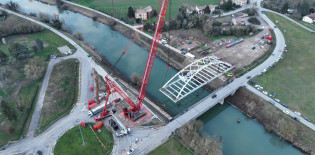
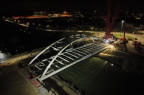
The existing bridge was replaced with a painted Corten steel bowstring arch bridge spanning the canal with a single 70-metre span, without any supports in the water. The deck is suspended from two one-metre-diameter tubular arches. At the top, the arches are connected by a truss bracing system that creates a distinctive diamond pattern, softened by the curved shaping of the connection plates: a solution that combines structural rigidity with aesthetic quality.

METALSAN delivered the project as part of a joint venture with Cadore Asfalti Srl, commissioned by Infrastrutture Venete.

  • A single span, a new connection

The Launch

Over 400 tonnes in motion

The launching of the new Trecenta arch bridge was a complex engineering operation, carefully planned and verified in every detail to move a steel structure fully assembled on the ground, with a total weight exceeding 400 tonnes.

The deck, fabricated and assembled in a dedicated construction area, was moved into its final position through the combined use of modular self-propelled transporters (SPMTs) and a high-capacity crawler crane. The horizontal movement was carried out by two SPMT convoys, each consisting of 16 axles with a capacity of 48 tonnes per axle, for a total capacity of 768 tonnes per convoy. Equipped with independent steering and synchronised electronic control systems, the transporters enabled a slow and controlled movement of the structure, ensuring an even distribution of loads across the travelling surface.

To overcome the canal and manage the cantilever phases, a Tadano CC 38.650-1 crawler crane with a 650-tonne capacity was used in Super Lift configuration. The crane progressively took over the front section of the deck during the advancement phase, allowing the removal of the front transporter convoy and the controlled transfer of loads from horizontal pushing forces to vertical lifting. During the most demanding phase, the crane operated with a lifting load of approximately 220 tonnes at a 32-metre radius, corresponding to around 79% of its available capacity. In the final stage, the combined action of the crane and the SPMTs enabled the bridge to be lowered onto its permanent supports with millimetre precision and tolerances below one centimetre.